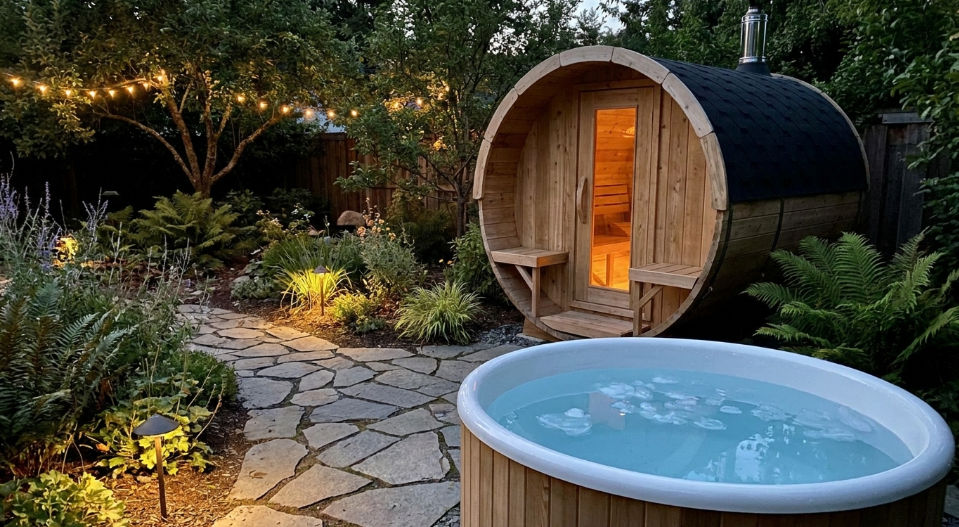
Winter delivers the sharpest hot-cold contrast a barrel sauna can offer, turns snow into a free cooldown option, and is when most specialty retailers discount inventory ahead of the spring rush. The tradeoff is installation: frozen ground makes a poured concrete foundation impractical in most climates, so many winter buyers order early and schedule the physical setup once the ground softens. For anyone who already knows they want a barrel sauna, winter is generally the better time to buy, even if actual use waits until spring.
Reason One: The Hot-Cold Contrast Is Bigger
Stepping from 15-degree outdoor air into a barrel running at 180 degrees is a far more dramatic sensation than the same transition on a mild fall evening, and that contrast is a big part of why sauna culture in cold-climate countries treats winter as the natural season for it rather than an inconvenience. The temperature gap does more of the physiological work, so a shorter session can feel just as intense as a longer one in warmer weather. Owners who use their sauna year-round consistently report winter sessions as the most memorable, not despite the cold outside but because of it.
Reason Two: People Actually Use It More Consistently
Counterintuitively, barrel sauna use tends to go up in winter rather than down. Cold, dark evenings create a stronger pull toward a warm, enclosed space than a pleasant summer night when there are a dozen other ways to spend the evening outdoors. Owners in cold climates commonly report their most consistent sauna habit forming in the winter months, then tapering off some in summer when schedules fill up with other outdoor activities. A structure that gets used consistently is the one that actually justifies its cost, which makes winter arguably the season where a barrel sauna earns its keep.
Reason Three: Snow Doubles as a Free Cooldown
A quick roll in snow or a bare-skin walk through cold air between rounds is a long-standing part of sauna tradition in colder climates, and it costs nothing beyond what winter already provides. It is worth being honest about the evidence here: cold exposure immediately after heat, or after exercise generally, produces mixed results in research, and some trials suggest it can blunt strength and hypertrophy adaptations if used too soon after resistance training. The appeal is largely sensory and traditional rather than a proven performance edge, but as an optional add-on to a winter sauna routine, it is a genuine perk that summer simply cannot offer.
Reason Four: Contractors and Electricians Have More Availability
Outdoor project demand, including sauna installs, typically peaks from spring through early fall, which means electricians and installers booking a winter job often have shorter lead times and more scheduling flexibility. A buyer who orders in winter and lines up the electrical work then can sometimes have everything ready to go the moment the ground thaws enough for foundation work, rather than joining a spring queue that stretches into summer.
Reason Five: Retailers Discount Before Spring Demand Hits
Demand for outdoor wellness structures climbs sharply as spring approaches, and manufacturers and retailers commonly price accordingly, discounting more heavily in the slower winter months to move inventory before that seasonal spike. Buyers comparing current pricing across specialty sellers, including SweatDecks, often find winter listings running below the same models’ spring pricing, sometimes by a meaningful margin on family-size units. Ordering in winter for a spring or early-summer installation is a common way to lock in a lower price without needing to use the sauna the day it arrives.
Reason Six: The Research on Heat Exposure Does Not Pause for Winter
The observational research behind sauna use, largely Finnish cohort data associating frequent use with lower rates of certain cardiovascular outcomes, comes from populations using saunas year-round in genuinely cold climates, not fair-weather users. A review of how the body adapts to repeated heat and cold exposure notes that consistency of exposure over time is a bigger factor in the associations researchers find than any single season being better or worse physiologically. In other words, the pattern that shows up in the data rewards regular winter use as much as regular summer use, since it is frequency over time that the research actually tracks.
What Getting to the Barrel Safely Actually Requires
A barrel sauna used through winter needs a cleared, non-slip path from the house, since the whole point of the routine is walking out repeatedly in cold air, sometimes barefoot or in sandals between rounds. A short run of textured decking, rubber matting, or simply a consistently shoveled path makes a bigger difference to how often the sauna actually gets used than most buyers expect going in. Owners who skip this step often find themselves reluctant to make the trip once ice sets in, which quietly undoes the consistency advantage winter is supposed to offer in the first place. It is a small, low-cost detail, but it is the kind of thing that separates a barrel sauna that gets used three times a week from one that sits mostly idle after the first cold snap.
The Honest Downside: Winter Installation Is Harder
None of this means winter is a frictionless time to install a barrel sauna. Pouring a concrete foundation in frozen ground is impractical in most climates, and even a gravel base takes more effort to excavate and compact when the top layer of soil is frozen solid. Many buyers split the process deliberately: order and even take delivery in winter to lock in pricing and avoid a spring backlog, then schedule the actual foundation and assembly work for once the ground has thawed enough to work properly. Anyone hoping to have a barrel sauna fully installed and running within days of a winter order in a genuinely cold climate should expect that timeline to be the exception rather than the norm.
Frequently Asked Questions
Is it harder to install a barrel sauna in winter? Frozen ground makes a concrete pad impractical in most climates, though gravel can still be built with extra effort. Many buyers order in winter and install once the ground thaws.
Do sauna retailers actually discount in winter? Many do, since demand for outdoor wellness structures typically peaks in spring and early summer.
Does cold weather make a sauna heater work harder? Yes, it has to work harder against a bigger indoor-outdoor temperature gap, meaning slightly longer heat-up times and marginally higher electricity use.
Is rolling in snow after a sauna session actually good for you? The evidence on cold exposure after heat is mixed. Some research suggests it can blunt strength and muscle-building adaptations, so it is more tradition than proven benefit.
References
- Association between sauna bathing and fatal cardiovascular and all-cause mortality events, JAMA Internal Medicine, 2015
- Effects of heat and cold on health, with special reference to Finnish sauna bathing, American Journal of Physiology, 2018
- Effects of cold water immersion after exercise on fatigue recovery and exercise performance: meta analysis, Frontiers in Physiology, 2023
- Benefits and risks of sauna bathing, The American Journal of Medicine, 2001